OpenMM PDB Fixer
Usage
Use OpenMM PDB Fixer immediately after loading or generating a PDB structure and before OpenMM Solvate, OpenMM Energy Minimize, or OpenMM Simulate. It is especially useful for downloaded PDB entries, antibody complexes, multi-chain proteins, structures with missing terminal atoms, alternate-location conflicts, non-standard residues such as MSE, and inputs that fail force-field matching downstream.
Typical workflow: Load PDB → OpenMM PDB Fixer → OpenMM ForceField Config + OpenMM Solvate → OpenMM Energy Minimize → OpenMM Simulate. For ligand-containing systems, set heterogen_mode to preserve, add an OpenMM Ligand Parameters node for each ligand residue, and pass those ligand parameters into OpenMM Solvate, OpenMM Energy Minimize, and OpenMM Simulate. For protein-only simulations, use remove_nonwater to strip ligands/cofactors/metals, and usually keep keep_water disabled so OpenMM Solvate can add a fresh, consistent solvent box.
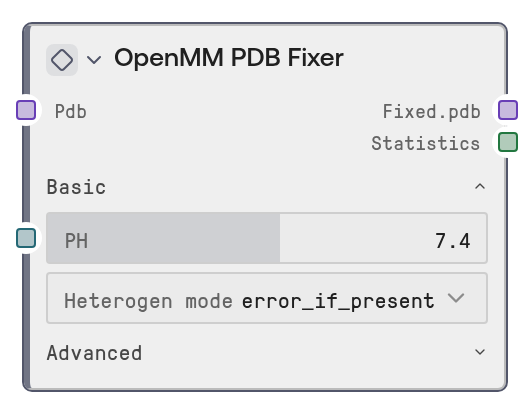
Best practice is to leave replace_nonstandard_residues enabled for crystal structures and use the default physiological pH of 7.4 unless your experiment requires a different protonation environment. Keep the default heterogen_mode=error_if_present when inspecting new structures, because it prevents accidental removal of a ligand or cofactor that may be scientifically important.
Inputs
| Field | Required | Type | Description | Example |
|---|---|---|---|---|
| pdb | True | PDB | Input PDB structure(s) to repair. Expects a dictionary-like PDB object where each entry maps a structure ID to PDB-format text containing parseable ATOM and/or HETATM records. | {'7KOO_antibody': 'HEADER IMMUNE SYSTEM\nATOM 1 N GLN H 1 12.414 23.810 8.921 1.00 42.18 N\n...'} |
| pH | False | FLOAT | pH used when adding hydrogens and assigning protonation states. Valid range is 0.0 to 14.0, with a default of 7.4 for physiological conditions. | 7.4 |
| heterogen_mode | False | COMBO | Controls handling of non-water HETATM residues such as ligands, cofactors, and metals. `error_if_present` stops when such residues are detected; `remove_nonwater` strips them; `preserve` keeps them for ligand-parameterized downstream workflows. | error_if_present |
| keep_water | False | BOOLEAN | Keeps water molecules from the input PDB when `heterogen_mode` is `remove_nonwater`. Usually leave this disabled because **OpenMM Solvate** adds a fresh explicit water box. | False |
| replace_nonstandard_residues | False | BOOLEAN | Replaces non-standard residues with canonical equivalents where possible, such as MSE to MET or phosphorylated residues to their base amino acids. Enabled by default and recommended for most simulation preparation. | True |
| timeout | False | INT | Maximum wait time per PDB structure in seconds. Default is 600 seconds; valid range is 60 to 3600 seconds. Increase for very large complexes or unusual structures. | 600 |
Outputs
| Field | Type | Description | Example |
|---|---|---|---|
| fixed.pdb | PDB | Repaired PDB structure(s), keyed by the same PDB IDs as the input. The output is ready for **OpenMM Solvate**, **OpenMM Energy Minimize**, or **OpenMM Simulate**, depending on whether the structure already has the required simulation setup. | {'7KOO_antibody': 'HEADER IMMUNE SYSTEM\nATOM 1 N GLN H 1 12.414 23.810 8.921 1.00 42.18 N\nATOM 2 H GLN H 1 12.027 24.632 8.476 1.00 42.18 H\n...\nEND'} |
| statistics | DATAFRAME | A table summarizing the fixed structures. Contains one row per input PDB with `pdb_id` and `num_atoms` columns. | [{'pdb_id': '7KOO_antibody', 'num_atoms': 6842}, {'pdb_id': '1HZH_fab', 'num_atoms': 6127}] |
Important Notes
- Heterogen safety: The default
error_if_presentmode intentionally stops when non-water HETATM residues are present, preventing accidental removal of ligands, cofactors, or metals. - Ligand workflows: If you set
heterogen_modetopreserve, downstream OpenMM nodes usually need matching OpenMM Ligand Parameters entries for each preserved ligand residue. - Water handling:
keep_wateronly matters whenheterogen_modeisremove_nonwater. For most workflows, leave input waters removed and let OpenMM Solvate create a consistent solvent box. - Performance: PDB fixing is usually fast for protein-only structures, but the timeout is applied per input PDB. Batch inputs can take up to
number of structures × timeout.
Troubleshooting
- Input pdb dictionary is empty. At least one PDB structure is required.: Connect a valid PDB-producing upstream node, such as Load PDB, and confirm the input contains PDB text rather than an empty object.
- Structure contains non-standard residues that PDBFixer would strip: Your structure contains ligands, cofactors, metals, or other non-water HETATM residues. Use
heterogen_mode=preservewith OpenMM Ligand Parameters, or useheterogen_mode=remove_nonwaterfor a protein-only simulation. - PDBFixer received empty PDB content: The upstream file input may have lost access to the uploaded file or produced no data. Re-upload the PDB file and rerun the workflow.
- PDBFixer produced an empty topology: The PDB content has no parseable ATOM/HETATM records or is not valid PDB text. Verify the file format and reload a valid structure.