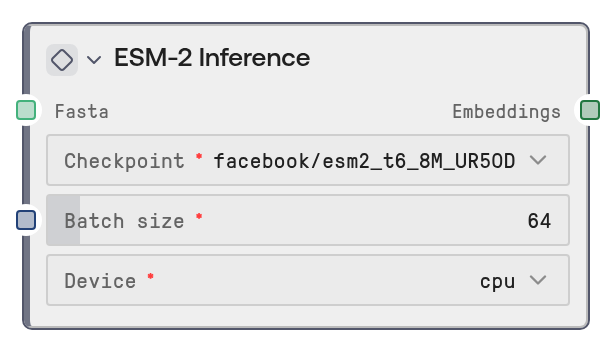
ESM-2 Inference
This node runs ESM-2 inference on one or more protein sequences provided in FASTA format and returns pooled sequence embeddings. It outputs a DataFrame with one row per FASTA record, preserving sequence IDs from FASTA headers and attaching each embedding as a numeric vector.
Usage
Use this node when you need numerical protein representations for downstream analysis, clustering, similarity search, classification, or machine-learning workflows. It is typically placed after a FASTA-producing or FASTA-cleaning node, such as nodes that load protein sequences, generate sequences, or extract FASTA text from biotech pipelines. The output works well with table-oriented downstream nodes such as DataFrame to CSV, DataFrame columns/list extraction, DataFrame join/concatenation nodes, or custom analysis nodes that consume DATAFRAME values. For exploratory work, start with facebook/esm2_t6_8M_UR50D on CPU for fast feedback; for higher-quality embeddings, choose a larger checkpoint and use CUDA when available. Keep FASTA headers unique because they become sequence_id values in the output, and tune batch_size based on available memory: larger batches improve throughput but increase RAM/VRAM use.
| Field | Required | Type | Description | Example |
|---|
| fasta | True | FASTA | Protein sequences in FASTA format. Each record should have a unique header and a non-empty amino-acid sequence. Multiple FASTA records are supported and produce one embedding row per record. | >spike_RBD_variant_A NITNLCPFGEVFNATRFASVYAWNRKRISNCVADYSVLYNSASFSTFKCYGVSPTKLNDLCFTNVYADSFVIRGDEVRQIAPGQTGKIADYNYKLPDDFTGCVIAWNSNNLDSKVGGNYNYLYRLFRKSNLKPFERDISTEIYQAGSTPCNGVEGFNCYFPLQSYGFQPTNGVGYQPYRVVVLSFELLHAPATVCGPKKST |
| checkpoint | True | COMBO | ESM-2 model checkpoint to use. Available options are `facebook/esm2_t6_8M_UR50D`, `facebook/esm2_t12_35M_UR50D`, `facebook/esm2_t30_150M_UR50D`, `facebook/esm2_t33_650M_UR50D`, `facebook/esm2_t36_3B_UR50D`, and `facebook/esm2_t48_15B_UR50D`. Larger models usually provide richer embeddings but require more time and memory. | facebook/esm2_t33_650M_UR50D |
| batch_size | True | INT | Number of sequences processed together per inference batch. Valid range is 1 to 1024, default is 64. Increase for better throughput when memory allows; reduce if inference fails due to memory pressure. | 16 |
| device | True | COMBO | Compute device for inference. Choose `cpu` for broad compatibility or `cuda` when an NVIDIA GPU is available. CUDA is much faster for large checkpoints but requires compatible infrastructure. | cuda |
Outputs
| Field | Type | Description | Example |
|---|
| embeddings | DATAFRAME | A DataFrame with columns `sequence_id` and `embedding`. `sequence_id` is taken from each FASTA header, and `embedding` is the pooled ESM-2 vector for that protein sequence. The embedding length depends on the selected checkpoint. | [{"sequence_id":"spike_RBD_variant_A","embedding":[0.0124,-0.0831,0.2217,0.0046,-0.1379]}, {"sequence_id":"spike_RBD_variant_B","embedding":[0.0189,-0.0794,0.2142,0.0113,-0.1285]}] |
Important Notes
- Performance: Larger ESM-2 checkpoints are significantly slower and require more memory. Use smaller checkpoints for iteration, then scale up for final embeddings.
- Timeout: The node waits up to 30 minutes for the ESM-2 service to return results. Very large batches, long sequences, or the largest checkpoints may approach this limit.
- Memory:
batch_size directly affects RAM/VRAM usage. If inference fails or stalls on large proteins, lower the batch size before changing the model.
- Behavior: FASTA headers are used as output IDs and must be unique. Empty sequences or invalid FASTA content will cause inference to fail.
Troubleshooting
- Invalid FASTA: If the node reports an invalid FASTA error, ensure the input starts with FASTA headers such as
>protein_id and that every header is followed by a non-empty amino-acid sequence.
- Duplicate sequence ID detected: Rename repeated FASTA headers so each record has a unique identifier; the node uses these headers as
sequence_id values.
- CUDA requested but not available: Switch
device to cpu or run the workflow in an environment with a compatible NVIDIA GPU.
- Out-of-memory or slow inference: Reduce
batch_size, choose a smaller checkpoint such as facebook/esm2_t6_8M_UR50D, or use CUDA for larger models when available.