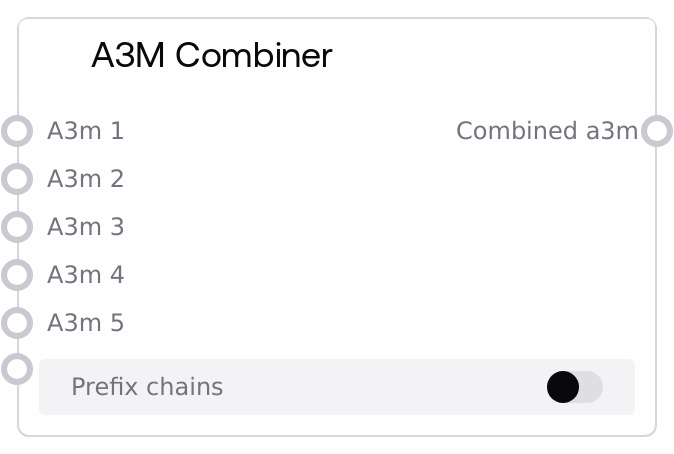
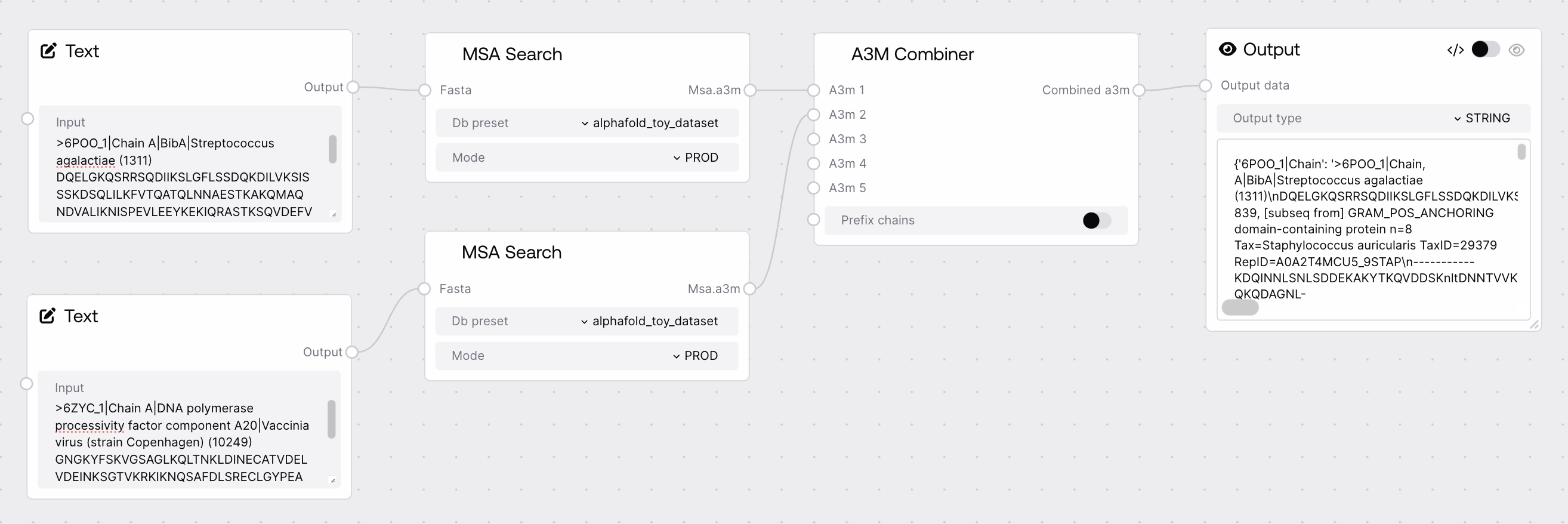
A3MCombinerNode merges multiple A3M MSA inputs, each as a dictionary mapping chain IDs to A3M-formatted strings, into a single combined A3M dictionary. It can optionally prefix chain IDs per input index to avoid collisions and auto-renames duplicates with numeric suffixes when needed. The node requires at least one non-empty A3M input and leaves the MSA string contents unchanged.
Use A3MCombinerNode when you have several A3M multiple-sequence alignments that must be provided as a single MSA object to downstream structure prediction or analysis nodes. Typical upstream nodes include LoadA3MNode and custom MSA generators that output the MSA type as a dict of {chain_id: a3m_string}. Place this node after all MSA preparation steps and before AlphaFold-style or other biotech nodes that accept one combined MSA input. Connect between one and five inputs (a3m_1–a3m_5); any that are unconnected or empty are ignored. Enable prefix_chains when different inputs reuse the same chain IDs (for example, multiple complexes or runs with chain "A") so that output keys become A3M1_A, A3M2_A, etc., ensuring uniqueness and traceability. For coordinated pipelines, align its chain ID conventions with PDBCombinerNode and FastaCombinerNode so that PDB, FASTA, and A3M refer to chains consistently.
First A3M MSA dictionary to include. Must be a dictionary mapping chain IDs (such as "A", "B", or "A_chain1") to A3M-formatted MSA strings. Ignored if missing, not a dict, or empty.
If true, chain IDs from each input are prefixed with "A3M{i}_" based on the input index (e.g., A3M1_A, A3M2_B). If false, original chain IDs are used and collisions are resolved by appending numeric suffixes (_1, _2, ...) instead of overwriting. Default behavior is false.
Single merged A3M MSA dictionary constructed from all non-empty inputs. Keys are unique chain IDs (optionally prefixed and/or suffixed) and values are the original A3M-formatted strings. This is the MSA object to feed into downstream prediction or analysis nodes that expect one combined MSA input.
Performance: The node only iterates over up to five dictionaries and copies keys/values, so it is lightweight; only extremely large MSAs will noticeably impact time or memory.
Limitations: At least one of a3m_1–a3m_5 must be a non-empty dictionary; otherwise the node raises a ValueError indicating that at least one A3M input is required.
Behavior: With prefix_chains set to true, chain IDs are prefixed by input index (A3M1_, A3M2_, etc.) and, if needed, numeric suffixes (_1, _2, ...) are added to keep keys unique.
Behavior: With prefix_chains set to false, repeated chain IDs across inputs trigger a warning and are disambiguated with numeric suffixes instead of overwriting earlier entries; MSA string contents are never altered.
Behavior: The node treats inputs as plain dictionaries and does not validate that value strings are syntactically correct A3M, so upstream processing must ensure valid A3M formatting.
Common Error 1: Error stating that at least one A3M input is required. This occurs when all a3m_1–a3m_5 are unconnected, None, not dicts, or empty. Connect at least one valid MSA dictionary output or verify that upstream nodes are producing non-empty MSA dictionaries.
Common Error 2: Downstream nodes see chain IDs like A3M1_A instead of A. This is caused by prefix_chains being true. Disable prefix_chains or adjust your PDB/FASTA nodes and downstream configuration to expect the prefixed IDs.
Common Error 3: PDB or FASTA inputs use chain IDs A, B, but the combined MSA uses A_1, A_2 due to conflict resolution, leading to mismatch in downstream tools that require matching IDs. Ensure chain IDs are unique across MSAs or harmonize naming by applying a similar prefixing/renaming pattern with PDBCombinerNode and FastaCombinerNode.
Common Error 4: Connecting a non-dictionary object (for example, a plain string) to an a3m_* input results in that input being ignored. Update the upstream node to output a dictionary of {chain_id: a3m_string} so it is included in the combined result.