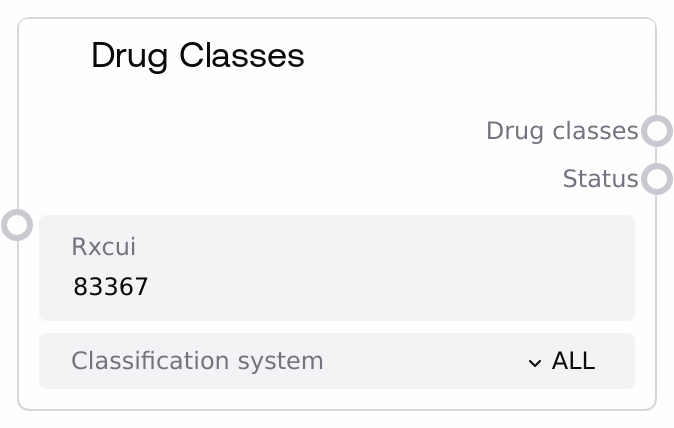
Drug Classes
This node queries RxClass via the RxNorm API to fetch drug classes associated with a specified RxNorm Concept Unique Identifier (RXCUI). It can limit the results to a selected classification system or request all supported systems. The node returns a JSON string wrapping the RXCUI, the chosen classification system, the raw class data, and a status message.
Usage
Use this node when you already have an RXCUI and need to understand which drug classes it belongs to across one or more classification systems (for example, ATC or VA) for formulary grouping, therapeutic categorization, or decision-support rules. It typically sits downstream of identifier-resolution nodes that map drug names or NDCs to RXCUIs, such as SaltAIRxCUIByNDC or a name-based RxNorm lookup node. A common pattern is: (1) resolve a drug name or NDC to RXCUI, (2) feed that RXCUI into SaltAIRxClassByDrug with an appropriate classification_system, and (3) pass the drug_classes JSON to analytics, reporting, or workflow nodes, or use it alongside SaltAIDrugClassAnalysis for deeper class and mechanism-of-action analysis. For robust workflows, always inspect the status output and be prepared to handle empty or error-bearing responses, especially when running batch jobs.
| Field | Required | Type | Description | Example |
|---|
| rxcui | True | STRING | RxNorm Concept Unique Identifier for the drug whose classes you want to retrieve. Must be a non-empty string (typically numeric) corresponding to a valid RxNorm concept. If this value is empty or consists only of whitespace, the node will not call the external API and instead returns an empty JSON object with an error status. | 83367 |
| classification_system | True | CHOICE | Drug classification system filter used when calling getClassesByRxNormDrugId. Allowed values come from RxNormAPI.drug_class_source_relations() and generally include systems such as ATC, VA, MEDRT, and others, plus an option like ALL to retrieve classes across all systems. Choose a specific system when downstream processes expect that ontology; choose ALL for broad or exploratory analysis. | ATC |
Outputs
| Field | Type | Description | Example |
|---|
| drug_classes | STRING | JSON-formatted string containing the classes associated with the given RXCUI. The structure includes the input RXCUI, the selected classification_system, and the raw class data returned by getClassesByRxNormDrugId. Downstream nodes should parse this string into JSON to inspect fields such as class identifiers, names, and types. | { "rxcui": "83367", "classification_system": "ATC", "classes": { "rxclassDrugInfoList": { "rxclassDrugInfo": [ { "rxclassMinConceptItem": { "classId": "C10AA05", "className": "HMG CoA reductase inhibitors", "classType": "ATC" }, "minConcept": { "rxcui": "83367", "name": "atorvastatin 10 MG Oral Tablet" } } ] } } } |
| status | STRING | Human-readable status message summarizing the result. On success, it confirms that drug classes were retrieved for the specified RXCUI. On failure, it contains an explanatory error message, including validation errors (such as empty RXCUI) or errors propagated from the RxClass/RxNorm API. | Successfully retrieved drug classes for RXCUI 83367 |
Important Notes
- Performance: Each execution makes an HTTP call to the external RxClass/RxNorm service. For high-volume workloads, consider caching frequent RXCUI lookups, batching operations, or adding rate limiting to avoid latency spikes or hitting external limits.
- Limitations: Even when the call succeeds, some RXCUIs may have no mapped classes in the chosen classification_system, resulting in an empty or minimal
classes structure. This reflects terminology coverage, not necessarily an error.
- Behavior: If
rxcui is empty or whitespace-only, the node skips the API call and returns "{}" for drug_classes with the status "Error: RXCUI cannot be empty".
- Behavior: When the external API reports an issue (for example, invalid parameters, network failures, or server errors), the returned JSON includes an
error field and the status output begins with "API Error:", which downstream consumers should detect before using the class data.
Troubleshooting
- Empty RXCUI input: Symptom:
drug_classes is "{}" and status is "Error: RXCUI cannot be empty". Resolution: Ensure an upstream node produces a valid, non-empty RXCUI string and that it is correctly wired to this node’s rxcui input.
- API Error from RxClass/RxNorm: Symptom:
status starts with "API Error:" and the drug_classes JSON contains an error entry. Resolution: Confirm that classification_system is one of the supported options, verify the RXCUI, and check the availability of the external service. Retry if the problem may be transient.
- No classes returned: Symptom: Status indicates success, but the
classes structure is empty or lacks expected rxclassDrugInfo entries. Resolution: Verify that the RXCUI corresponds to a concept that has class mappings in the selected system. If needed, rerun with ALL or another system (for example, VA instead of ATC) to see if mappings exist elsewhere.
- Downstream JSON parsing issues: Symptom: Nodes consuming
drug_classes fail due to type or key errors. Resolution: Make sure downstream logic parses drug_classes from a string into JSON before accessing fields, and handle cases where an error field is present or where expected lists like rxclassDrugInfoList are missing.